


With a tremendous mounting excitement, Wishford is about to host its inaugural FIRST Lego League regional competition at Westonbirt School. A year in the planning, it is just the latest development in the outstanding, award-winning STEM curriculum, that transforms our pupils’ understanding of, and relationship with, technology. The force behind it all is Wishford’s Educational Technology Lead, Camilla Evans, and on Tuesday 20 January, she will be donning a sequinned jacket to co-host an event where STEM meets razzmatazz!
If you have not come across them before, FIRST Lego League competitions challenge young people across the globe to research, design and engineer Lego robots for a particular purpose, and code them to complete a series of tasks. They are challenging in the most exciting way; real-world quests for pupils to solve and execute, using a wide range of skills to suit different strengths and personalities. Every year, there is a new theme. For 2026, Unearthed requires children to tackle the sorts of problems faced by archaeologists – how to locate artefacts below ground or sea, how to work to a tight excavation timescale, how to preserve treasures once retrieved.
The competition is structured in such a way that it gives every child an opportunity to showcase their own particular skills. Competitors are marked in four categories; Robot Design, Robot Game, the Innovation Project; and – what Camilla cites as the most important – Core Values, which includes elements such as teamwork, discovery, innovation and fun! The Robot Game gives the competitors three chances to put their robot on the competition table for two and half minutes and complete a range of tasks – trigger an action, retrieve a model, follow a set path etc. It is the high-pressure part of the competition, and tends to get the most attention, but it is only the final stage of a process that has taken months of research, learning and preparation, and weeks building, coding and practicing. And it’s not the only activity on the day. The team will also have to explain their choices in the robot’s design or present the Innovation Project to judges. For this they will have considered challenges facing archaeologists and come up with potential solutions. We have teams looking at how technology can preserve artefacts from degrading once out of the ground, while the senior school team is exploring how the many thousands of artefacts that are never on display at museums might be brought into schools digitally.

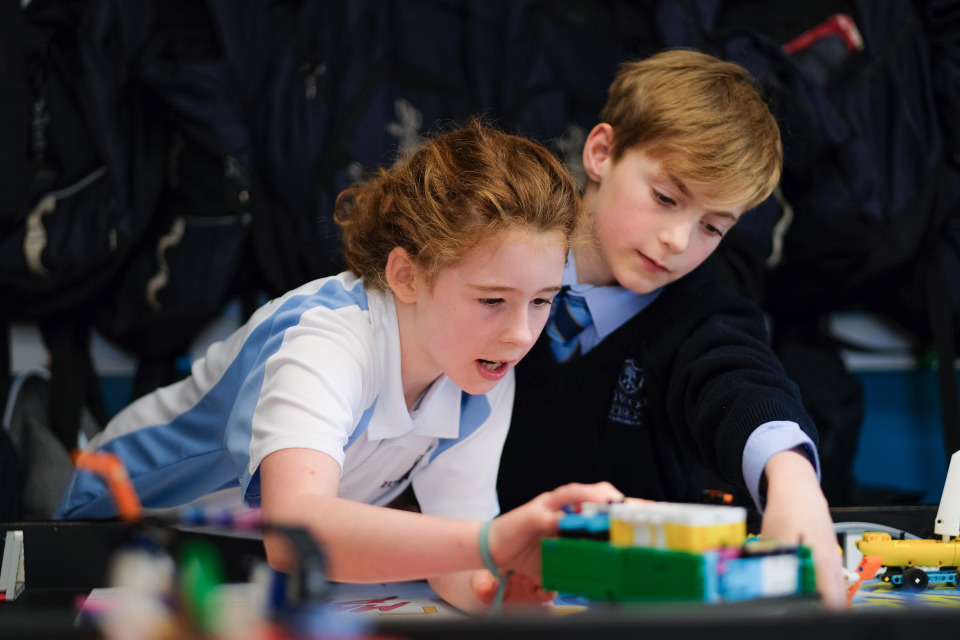
From an educational perspective, Lego robotics hits a golden intersection. It helps develop a wide range of important scientific, technological and critical thinking skills, but is also just enormous fun – a powerful recipe that has turbocharged our students’ learning and engagement in STEM.
How it came about is testament to Wishford’s commitment to be at the leading edge of technological education – backing this with around £50,000 of investment in resources – as well as Camilla’s undoubted expertise, passion and enthusiasm. Wishford first got involved in Lego robotics back in 2015, when primary-aged competitors were rare. In 2022, Heywood Prep’s Cargonauts team made it all to way Houston, Texas, to represent the UK in the World Finals. This year, we have 170 children from five Wishford schools participating, with other schools raring to go. We have so many teams, we tend to overwhelm other regional events, so the decision was made to host our own, this year for Wishford schools only, but with the plan to open it out to other regional schools in future.
The competition provides an interesting insight into how Wishford disseminates outstanding learning practices in a way that is both effective and practicable. As Educational Technology Lead, Camilla is rolling out the STEM and Computer Science curriculum that she has developed, and which has won the ISA Innovation and STEM award as well as the Space Education Quality Gold Mark. Lego robotics forms part of this, using the Engineering Design process as the basis for all STEM topical learning, and Camilla spends time working with staff across our schools, upskilling them so that Lego robotics, and its associated skills, are intrinsic to the pupils’ learning, rather than an additional component to be resourced.
Having high-quality teachers is critical to delivering something as ambitious as a competition on this scale. But the whole Wishford community is involved here. Camilla has pulled in volunteers from across academic staff and support staff (our IT department finds itself particularly popular), as well anyone in the parent community with experience in engineering, coding and associated skills. We have an iterative designer, a marine bioscientist, a cyber security expert and an AI specialist across our judging teams, underlying the real-world relevance of what our children are learning. As beginners, we will also be supported by one of the head referees for the UK finals. Plus two members of Heywood’s successful Cargonauts – now in Year 10 – will be around to inspire and support the competitors.
The impact on our pupils has been marked. Teamwork, diplomacy and compromise are as important as the technical skills, and these have been supported and developed. As their experience and success increased, pupils petitioned for and secured additional investment from Wishford for higher-tech robots. Camilla talks about how the experience also helps pupils mature emotionally. She cites a talented and competitive player at the World Finals, who recognised that two of his teammates would be more composed under pressure at the table for the Robot Competition, and willingly stepped back. ‘That took reflection and courage, and he went onto to cheer and support them.’
Now at Westonbirt, the preparation is fully underway. The smooth running of the competition – housing 170 children comfortably in their teams, moving them efficiently from task to task, resetting competition tables, keeping competitors fed and watered – takes a PhD in logistics. On top of that, the event is wrapped in pure spectacle. The Leisure Centre at Westonbirt will be transformed with dramatic canopies and extravagant lighting effects. There are sound systems, and confetti canons, as well as songs and dances to be learned and performed between competitive sessions, to keep children enthused and busy. And at the end of the event, at least one trophy to take a team to the UK finals.
What an experience. Roll on Tuesday!