
It is a common concern amongst parents that children may be spending too much time on devices, both at home and in school. A recent BBC article highlights the potential issues surrounding too much screen time, in relation to eyesight and hearing. Equally, many parents may be concerned about their children’s attention span, when the aim of social media seems to be to encourage endless scrolling through ever-changing short video content. Alongside these concerns, any parents will also want to ensure that their children are well-prepared for the future, without being left behind, as technology seems to progress at an increasingly rapid pace.
At Wishford Education, we’re acutely aware of the need to balance both of these views. We recently held an event for parents with Will Orr-Ewing as a guest speaker. Will co-founded Generation Alpha CIC, a group to campaign for a complete ban on smartphones in schools and launched a judicial review against the Government, arguing that the Department for Education’s failure to mandate a ban on smartphones in schools was a breach of its legal duty of care to children. The national conversation about smart phones in schools has led to real change, at government level, to reduce the impact of social media and the constant need to engage with it, when pupils ought to be focusing on learning.
But the current concern is about more than just smartphones. What other devices do our children have access to? How long are they spending on them each day? Many parents will be worried about the impact of spending an entire day using screens in lessons, followed by an evening of online gaming, and rightly so.
Across our various schools, pupils have access to school devices from Year 4 upwards. But our core principle is that those devices should be used only when they enhance learning. A broad and balanced education involves a wide variety of techniques, activities and experiences, which go well beyond simply sitting in front of a screen.
A Typical Wishford Week
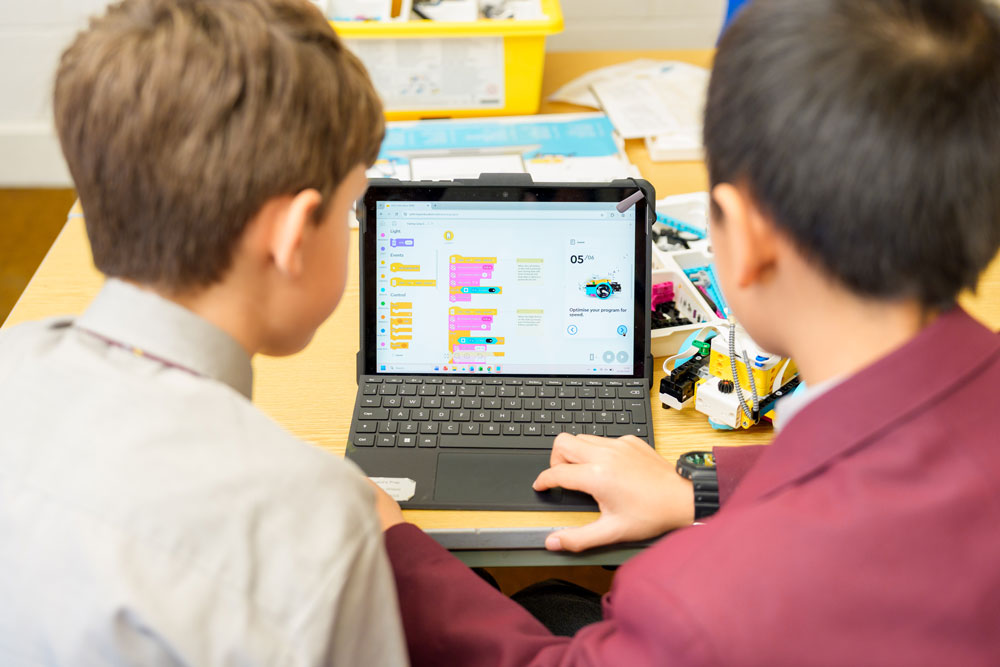
Whilst our pupils have access to devices in lessons, they are used only when the teacher deems it appropriate and when it is best for learning. There are plenty of examples where this has a positive impact on the outcomes for pupils, such as researching a topic, creating a shared document in a group, completing quizzes and flashcards, or writing code. Having said that, devices might often be used for only a few minutes within a lesson, or indeed not at all.
Frequently, teachers will favour handwritten activities (using a real pen!) and there is clear evidence that recall is higher when notes are written by hand, rather than typed. But a typical day in a Wishford school involves engaging activities of all kinds, from practical experiments and activities to the wide range of clubs and societies which combine to form a balanced and rounded education. Sport, music, drama, and whole smorgasbord of clubs, societies and enriching activities will fill the day, encouraging time outdoors, practical activity and experimentation.


There is good evidence that writing by hand aids learning. Equally, there is also good evidence that moderate and purposeful use of technology can improve outcomes for children. Our focus is on finding the right balance, to enhance learning using the best methods available, whether they are analogue or digital.
Wishford’s Director of Education & Innovation, Simon Balderson puts this point at the heart of our approach to a well-rounded education. “The ability to use technology effectively is a fundamental skill, both in education and the world of work,” he says. “This trend is only accelerating with the increasing use of artificial intelligence and, as such, we have a responsibility to prepare our pupils for the future. The skills needed for a rapidly changing world of work and the purpose of education as a whole were the focus of discussions at our recent AI x EI conference. We explored the critical role Emotional Intelligence plays in schools, as AI is increasingly able to automate tasks, generate content and handle more aspects of our daily lives. Crucially, we concluded that the skills which are needed to use AI most effectively are those which make us most human: creativity, teamwork, empathy and leadership. All of these can be found being nurtured and developed in activities well away from screens, whether that is the Debating Society, CCF, the Bee-keeping club or the Equestrian team.”

Camilla Evans, Wishford’s Educational Technology Lead, also highlights the distinction between simply spending time on a screen and using technology purposefully. “A pupil might use a device to research and evaluate information, collaborate with others, programme and debug a robot, or develop a design that will become a physical object through a 3D printer or laser cutter. Along the way, we are teaching children to question sources, think critically and navigate the enormous amount of information they will encounter in their lives. Technology can also remove barriers: tools such as dictation, Read Aloud, Immersive Reader and screen readers can make learning more accessible, and good inclusive design often benefits everyone. None of this means replacing books, handwriting, discussion, practical work or time outdoors. It means choosing the right tool for the learning, rather than using technology for its own sake.”
Ultimately, our aim is to work collaboratively with parents, so that positive habits around the use of technology are encouraged consistently, both at home and in school. We are very happy to support parents to reinforce messages around consistent routines, reducing the distractions of technology and using it in way which will enhance, rather than detract from learning.
“A child with a future in computer science may well spend some of their day writing code,” Simon says, “but they will also most likely spend the rest of it painting, playing music and return home covered in mud after games!”